


When you buy or work with synthetic food colours, you may see different numbers and names for the same colour.
For example, CI 15985, CAS 2783-94-0, INS 110, E110, FD&C Yellow No. 6, or simply Sunset Yellow FCF. This makes things confusing, especially when purchasing colours, checking a supplier’s specification, technical data sheet, Certificate of Analysis (COA), or regulatory documents.
Although these different identifiers can refer to the same colour, they do not mean the same thing. Each system has a different purpose.
In this article, we will understand how the differences between C.I., CAS, INS, E numbers, and FD&C names can help food product manufacturers, food colour distributors, importers, suppliers, formulators, and purchasing teams identify the right colour before buying.
A Quick Comparison
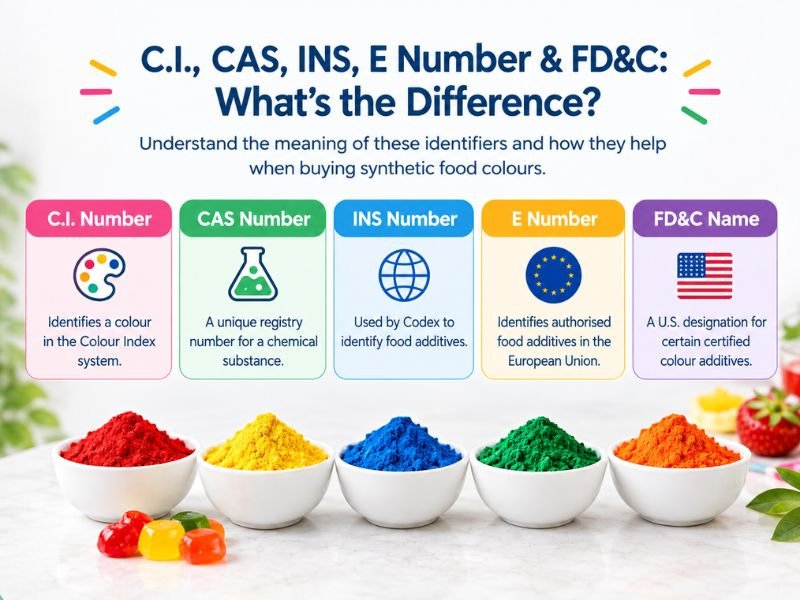
C.I., CAS, INS, E numbers, and FD&C names are different systems of identification or naming used for identifying colours and food additives.
C.I. Number: This identifies a colour in the Colour Index system.
CAS Number: A unique number assigned to a chemical substance or component in the CAS registry.
INS Number: An International Numbering System identifier used by Codex for food additives.
E Number: A European Union food additive identification number.
FD&C Name: A U.S. FDA designation used for certain certified colour additives permitted for specific uses.
Now let's understand each one in detail.
What Is a C.I. Number for Food Colours?
C.I. stands for Colour Index. A C.I. number is used to identify a particular colourant in the Colour Index system.
Food colour suppliers and manufacturers often list the C.I. number for a colour alongside its common colour name and other identification numbers. For example, the FDA's colour-additive database lists C.I. 15985 as one of the names for Sunset Yellow FCF.
A C.I. number can be useful when:
- It identifies a specific colourant
- Helps to compare information from different suppliers
- Checking technical specifications
- Searching colour databases
- Matching a colour with its other known names
- Communicating about a colour internationally
However, a C.I. number does not prove that a colour is approved for a particular food use in a particular country. You must check the applicable regulations to ensure that the colour is permitted for the intended use. This is very important for suppliers who buy colour to export to the international market.
What Is a CAS Number?
CAS stands for Chemical Abstracts Service. A CAS Registry Number (CAS RN) is a unique chemical substance identifier. The FAO/WHO JECFA database explains that a CAS number may identify a food additive or a component of an additive.
A CAS number is commonly used for:
- Chemical identification
- Technical specifications
- Safety Data Sheet (SDS)
- Lab work
- Chemical databases
- Research and development
- Regulatory documentation
- International communication between suppliers and buyers
For example, the FDA’s regulatory database lists FD&C Red No. 40 as CAS 25956-17-6.
Why Is the CAS Number Important to Food Colour Buyers?
If a manufacturer is sourcing a synthetic food colour, the CAS number can help them to confirm the identity of the substance being discussed.
However, food colour buyers should not rely only on the CAS number. The complete specification, grade, purity, regulatory status, intended application, and documentation should also be checked properly.
What Is an INS Number?
INS stands for International Numbering System. This numbering system is used by Codex Alimentarius to identify food additives. The FAO/WHO JECFA database specifically allows users to search food additives by their INS number.
For example, Allura Red AC is listed as INS 129 in the INS numbering system. INS numbers are useful when discussing food additives across international markets.
However, an INS number identifies a food additive; it does not by itself mean that the additive is approved for every food product or country. Manufacturers should check the food regulations and conditions in the destination market to ensure that the colour they are using in their product is approved for use in that specific country.
What Is an E Number?
An E number is used to identify food additives that are authorized for use in the European Union under applicable food regulations.
You may see food colours identified with numbers such as:
- E102 – Tartrazine
- E110 – Sunset Yellow FCF
- E129 – Allura Red AC
- E133 – Brilliant Blue FCF
It is important that the manufacturer first ensures that the food colour is approved for use on the market. Regulatory requirements and permitted use need to be checked for the specific market and food category.
What Is an FD&C Name?
FD&C stands for Food, Drug, and Cosmetic. This colour additive identification system is used in the United States. The FDA maintains the list of permitted colour additives and their specific uses and restrictions.
These colour additives are listed in the FD&C numbering system as:
- FD&C Yellow No. 5
- FD&C Yellow No. 6
- FD&C Red No. 40
- FD&C Blue No. 1
- FD&C Green No. 3
For example, the FDA identifies FD&C Red No. 40 as a permanently listed color additive subject to certification, with permitted uses and restrictions specified in U.S. regulations. So, an FD&C name is not simply another name for a C.I. number. It is part of the U.S. system for identifying certain colour additives and their permitted uses.
C.I. vs CAS vs INS vs E Number vs FD&C
The easiest way to understand these identifiers is to compare their main purpose.
| Identifier | What It Means | Main Purpose | Example |
|---|---|---|---|
| C.I. Number | Colour Index identifier | Identifying a colourant | C.I. 16035 |
| CAS Number | Chemical Abstracts Service Registry Number | Identifying a chemical substance/component | 25956-17-6 |
| INS Number | International Numbering System | Identifying food additives | INS 129 |
| E Number | European food additive designation | Identifying food additives in the EU | E129 |
| FD&C Name | Food, Drug & Cosmetic designation | U.S. colour-additive identification | FD&C Red No. 40 |
The same colour can therefore appear under several identifiers, but each identifier serves a different purpose.
Example: Allura Red AC Under Different Identifiers
Let's take Allura Red AC as an example.
Depending on the document or database you are checking, you may find these things there:
- Common name: Allura Red AC
- C.I. Number: C.I. 16035
- INS Number: INS 129
- E Number: E129
- FD&C Name: FD&C Red No. 40
- CAS Number: 25956-17-6
FDA's regulatory database identifies FD&C Red No. 40 with CAS 25956-17-6 and lists other names associated with the colour.
This example shows that buyers may find multiple identifiers when researching or purchasing the same colour.
Why Do Food Colour Manufacturers Use Multiple Identifiers?
Synthetic food colours or the products prepared with synthetic food colours are supplied internationally, so manufacturers and buyers may work with different regulatory systems, technical documents, and databases.
A supplier may therefore include several identifiers on a specification sheet.
For example, a technical document may contain:
Product Name → C.I. Number → CAS Number → INS/E Number → Regulatory Name → Specifications
Providing multiple identifiers can make it easier to:
- Confirm product identity
- Match customer requirements
- Prepare technical documentation
- Check regulatory information
- Communicate with international buyers
- Compare supplier specifications
- Reduce the possibility of selecting the wrong colour
JECFA's food additive database itself supports searches by additive name, INS number, CAS number, and functional use, showing how these identifiers can be useful for technical and regulatory research.
How Food Colour Buyers Can Use These Identifiers
Whether you are a Food manufacturer, importer, distributor, or a colour purchasing professional, these colouring identifiers can help you source the right colour.
1. Verify the Name of the Colour
First, use either the commercial or common name of the colour.
For Example: Allura Red AC
2. Verify the C.I. Number
The use of the C.I. number helps to identify the colour.
3. Verify the CAS Number
Compare the colour’s CAS number to that shown in the supplier’s technical data or safety data sheet (SDS) to identify it.
4. Verify the INS/E Number
Check the ID and regulatory status of the food additive in the customer’s market.
5. Verify the Regulatory Status
Do not assume identification of a colour means approval for the intended use.
Always check the regulations for:
- Your country
- Your food category
- Your intended application
- The concentration or the level permitted.
6. Request Technical Documents
Before buying food colour in bulk, request that the supplier:
- Provide the technical data of the product
- A Test report of the product (COA)
- Safety Data Sheet (SDS), where applicable
- Regulatory/compliance data
- Provide product data
- Give instructions for the packaging and storage
These documents provide the buyer’s quality and procurement teams with relevant information to evaluate the material.
Final Takeaway
C.I., CAS, INS, E numbers, and FD&C are different identification systems used to identify colours and food additives. Colour buyers, manufacturers, suppliers, labs, and regulatory groups benefit from understanding the different identification systems.
When purchasing a synthetic food colour, do not look only at the identification number alone. You have to confirm the colour identity, technical specification, intended application, regulatory status, documentation, and supplier reliability.
If you are looking for a synthetic food colour supplier, Ajanta Food Colours is one of the leading manufacturers you can consider. With more than 75 years of legacy in food colour manufacturing, Ajanta Food Colours understands manufacturers' colour requirements and product needs.
Before buying food colours, you need to check the proper colour documentation, desired shade, quality, specifications and whether it is suitable for your product and the target market. Ajanta Food Colours also helps buyers to understand these requirements and choose the right colour for their application.
Want to learn more about synthetic food colours, C.I., CAS, INS, E numbers, FD&C names, or discuss your colour requirements? Contact us today!